Thesis: Castles created the modern state. Part 1 of the series explores the technology and why it was so important to medieval Europeans. It answers, “But why castles?”
In any specific action, in any measure we may undertake, we always have the choice between the most audacious and the most careful solution. Some people think that the theory of war always advises the latter. That assumption is false. If the theory does advise anything, it is the nature of war to advise the most decisive, that is, the most audacious. Theory leaves it to the military leader, however, to act according to their own courage, according to their spirit of enterprise, and their self-confidence. Make your choice, therefore, according to this inner force; but never forget that no military leader has ever become great without audacity.
— Clausewitz, Carl. “Principles of War.” Military Service Publishing Company, 1942. Accessible here
Medieval rulers would have heartily disagreed with von Clausewitz. Their constraints and dogma would have led them to say, “why not both?” Why not have your cake and eat it too? The most careful solution and the most daring one at the same time?
What if you could have defense and offense in a single, elegant solution?
Historians have wondered for a long time where lords acquired their powers of justice and command. […] Others have seen the origin of seignorial power in the droit de ban - the right to command, coerce, and punish originally delegated.by the king to his officers and then increasingly appropriated by them. […] Current research leads us, to think that without the instrument represented by the motte and bailey castle, the final appropriation of the droit de ban by the king’s officers or the usurpation of this power by the wealthiest landowners would never have taken place. The motte accelerated the tipping of the balance of power toward the seignory. […] The most important factor was the lordship inherent in possession of a castle; the motte and bailey castle crystallized power and in some cases even created it.
— Bur, Michel. “The Motte and Bailey Castle: Instrument of Revolution.” Engineering and Science 45, no. 3 (1982): 11-14.
As with old music, there’s a selection bias in the castles we remember. In our collective consciousness, we associate the word castle with beautiful buildings like these,

Buildings exemplary both in history and their beauty. But they’re the exceptions, not the rule.
Early castles were stark in their simplicity. They had to be because of their strategic role in capturing territory. Soldiers would arrive onto foreign land, temporarily secure it, create a castle,1 leave a garrison, and then move on. It has been suggested by some historians that between the start of William the Conqueror’s invasion in 1066 and his death in 1087, his army had built at least 500 castles across England.2 Somewhere between 500 to 550 of these were occupied at the time of his death.3
The overwhelming majority of these castles were cheap and disposable. Dollar store castling. Affordable earthen mounds and wooden walls — within reach for even the most impoverished of feudal lords. Typically taking the motte-and-bailey form,
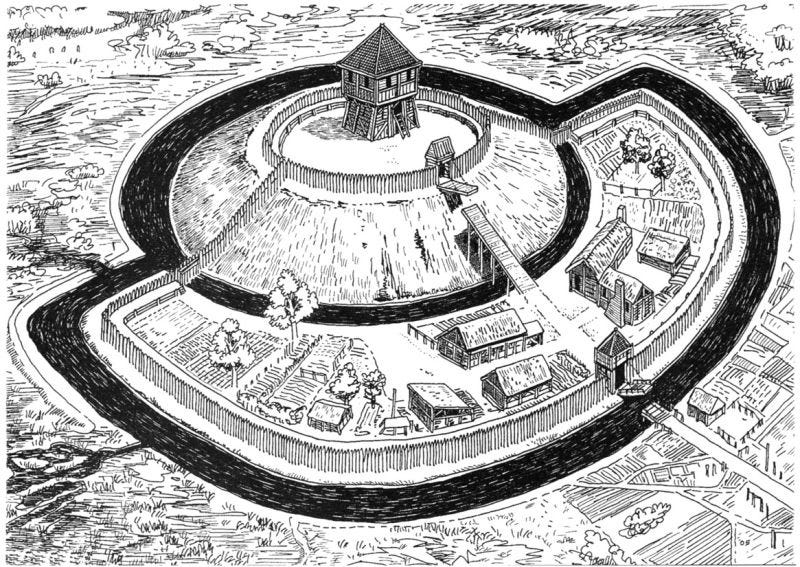
When medieval rulers c. 900 AD built castles, they mostly built motte-and-baileys. And they did so in astonishingly scrappy ways. More generally, early medieval rulers built, used and abused castles in radically different ways than the pop-culture, Disney movie version of castling.
I worked with an amateur archaeologist and trained architect, J. Lyonsmith, who studies historical European martial arts and the way in which Europe once waged war. Using archaeological data, dig findings, and a 3D photogrammetric map, we studied a small motte-and-bailey, Castle Pulverbatch in Shropshire, England.
Pulverbatch is an exceptionally preserved, entirely wooden motte-and-bailey, offering us a great example of what it could have been like to build one of these castles. It’s hard to do the site justice with photos alone, via the 3D aerial survey map,
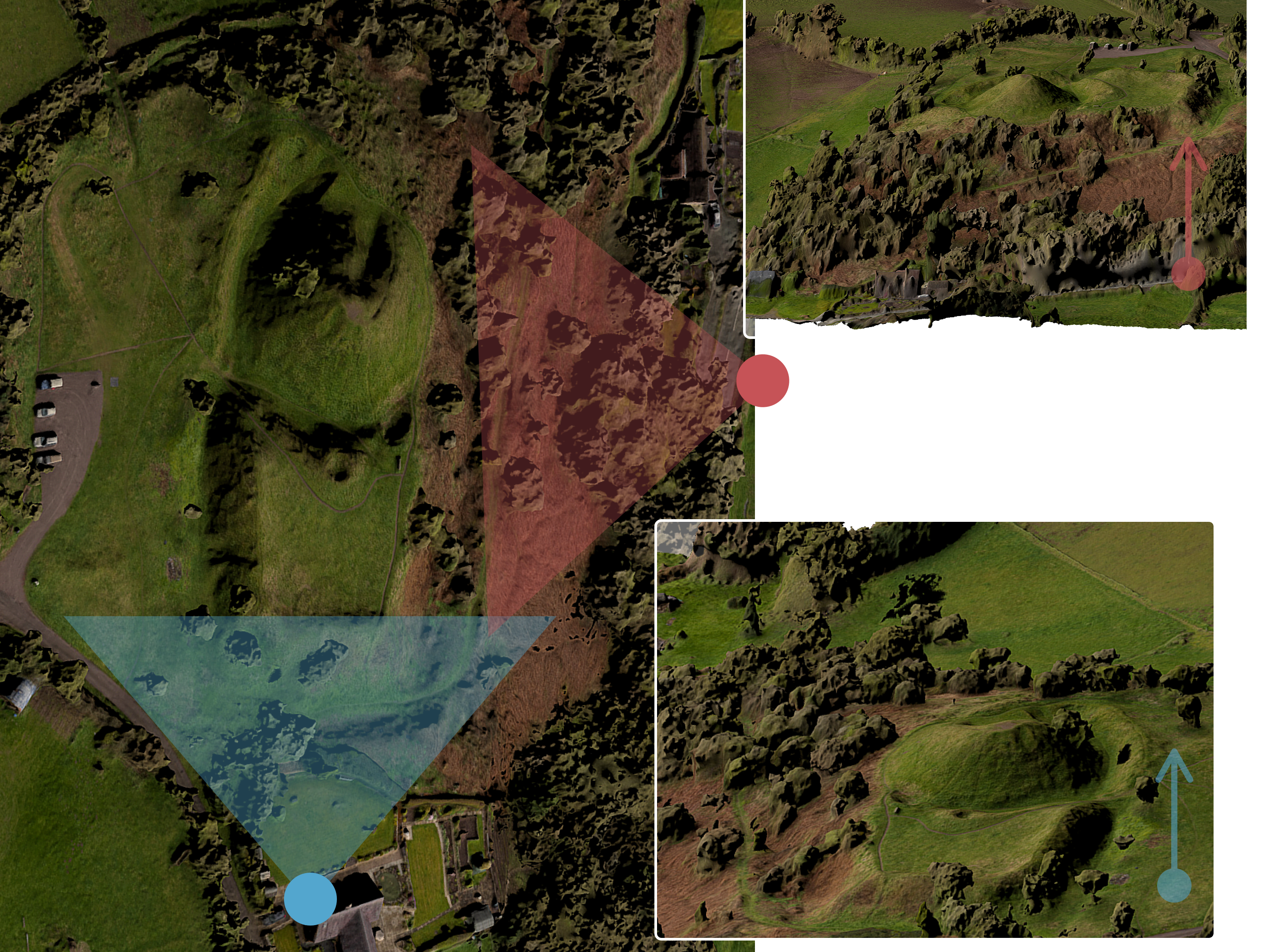
Pulverbatch shows one of the most counter-intuitive things about ancient warfare; they loved to dig build. The Romans would set up palisades and fortifications at every given opportunity. They were so prolific that they exported their techniques to their enemies;
Disappointed in this hope, the Nervii surround the winter-quarters with a rampart eleven feet high, and a ditch thirteen feet in depth. These military works they had learned from our men in the intercourse of former years, and, having taken some of our army prisoners, were instructed by them: but, as they had no supply of iron tools which are requisite for this service, they were forced to cut the turf with their swords, and to empty out the earth with their hands and cloaks, from which circumstance, the vast number of the men could be inferred; for in less than three hours they completed a fortification of ten miles in circumference; and during the rest of the days they began to prepare and construct towers of the height of the ramparts, and grappling irons, and mantelets, which the same prisoners had taught them.
— Caesar, Julius. “Commentarii de bello Gallico” c. 49 B.C. Translated & Re-published as “The Gallic Wars.” by W. A. McDevitte and W. S. Bohn, Harper & Brothers, 1869. Accessible Here. (Caesar 5:42)
Even when deep in enemy territory, a Roman legion on the march would set up a fortified, highly-organized camp by the end of the day. Their carpenters and military engineers could create a cheap, disposable fort within hours under enemy fire. Much like cats, the Romans (and William the Conqueror) would find a spot that fits and would sit (behind a ditch with fortified wooden walls).
Very little evidence remains that tells us exactly how Pulverbatch was built nearly a thousand years ago. Thanks to archaeologists, we know a lot about the era’s construction techniques, but we don’t have a Castle Pulverbatch “recipe.” Or, a comprehensive set of techniques that would let us faithfully recreate their work with era-appropriate tools.4 But what we do have is a beautifully embroidered, descriptive tapestry — the Bayeux Tapestry,
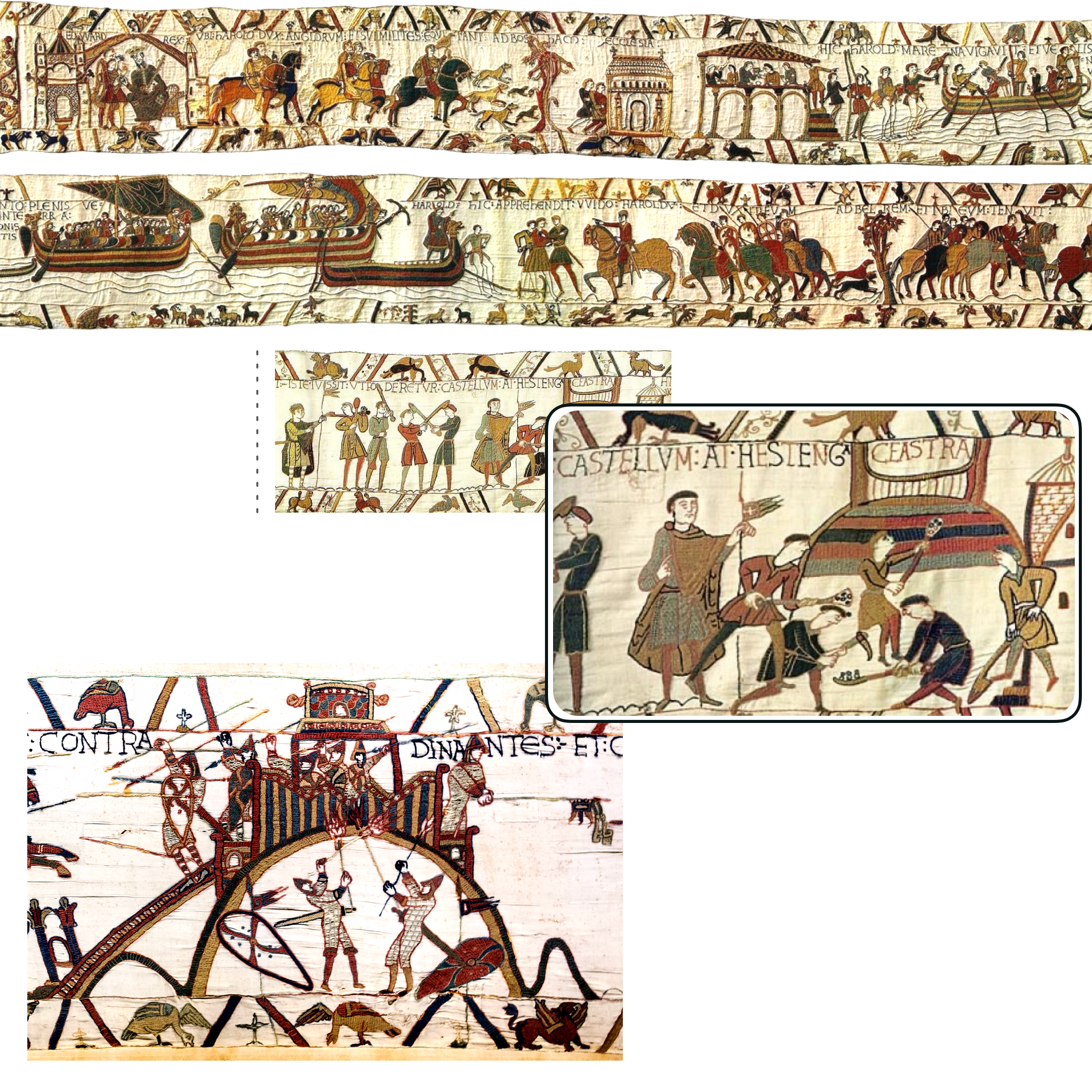
Legend has it that the tapestry was commissioned and created by William the Conqueror’s wife Queen Matilda and her ladies in waiting. Others contend that it was commissioned by his half brother, Odo – who was a bishop at Bayeux. But no matter who commissioned it, its beauty and utility remain the same. The tapestry portrays the most crucial ingredient of the Pulverbatch-era motte-and-bailey recipe – mechanically stabilized earth,

Or, in more detail,
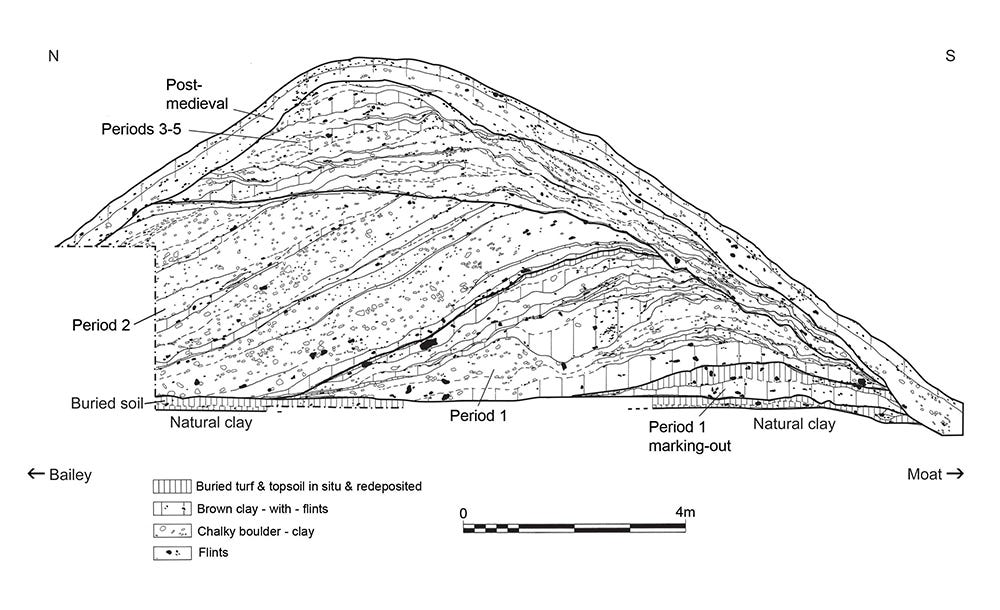
Ignoring the palisade and subsequent construction (that made the castle a castle), we can simplify and describe the initial process as,
Establish the castle’s perimeter
Dig a ditch along the perimeter
Move the dirt to one end of the site
Layer the dirt as you pile it and shape it into a mound
Put clay along the exterior of the mound.
This recipe was simple enough and castles were important enough that medieval rulers would have their their soldiers (and subjects), to quote Caesar, “cut the turf with their swords, and to empty out the earth with their hands and cloaks.” The initial simplicity of motte-and-baileys allowed armies to brute force security.
There is a case to be made that they were (maybe) too simple. There was – apparently – a persistent problem of “illegal castling.” During a civil war or succession crisis, the disputing parties would start by building castles in disputed territory,
A similar phenomenon of “illegal” castle building occurred in times of crisis, such as succession or wardship, particularly around the middle of the 11th century in territories that were otherwise well under control. When the ruler recovered his power, he usually preferred to formalize the status quo rather than start a war with the new castle owners who had appeared during the crisis. In the long run, however, even these illegal castles usually ended up acquiring legality by agreement between parties. Those that stayed totally independent were very rare.
— Bur, Michel. “The Motte and Bailey Castle: Instrument of Revolution.” Engineering and Science 45, no. 3 (1982): 11-14.
All of the other trappings of castling that we see in classic diagrams of motte-and-baileys – the palisade, stone keep, draw bridge etc. – would usually be added over time. Doing a motte-and-bailey was – for the most part – an exercise in shoveling dirt more efficiently than the enemy.
Beyond the obvious defensive benefits, it’s worth asking – why? Why did they do this? And why was it so effective?
To understand why castles matter, we really need to understand wagons. The Tyranny of the Wagon Equation is my favorite post on this website. I had never given it much thought before, but it turns out that medieval logistics share a lot in common with the rocket equation. Roughly;
To get X (armies, explorers, astronauts, etc.) from A to B, you need a Resource R which is also a resource that you want to deliver at the end (food for the army, fuel for the explorers to explore with). If the thing (donkeys, horses, hydrazine, RP-1) that pushes X also consumes R, then the amount of R needed to get from A to B grows non-linearly as the number X increases.5
In the post, the author shares an amazing series of diagrams showing what the wagon equation leads to in the real world,
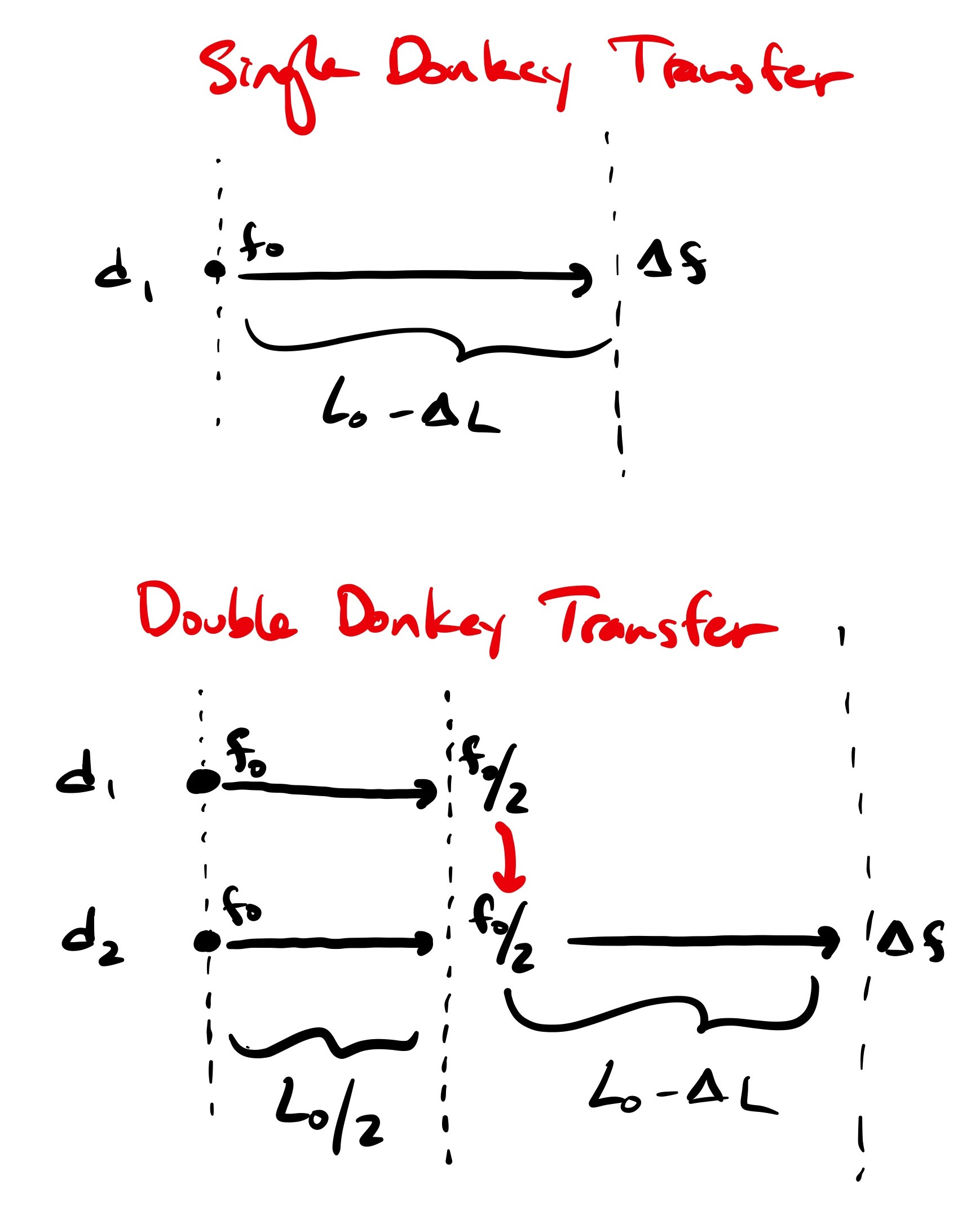
You may think this diagram is merely a fellow nerd’s conceit, but for most militaries, it is a force as fundamental as gravity. When Argentina invaded the Falklands in 1982, a part of the UK’s answer was this diagram,
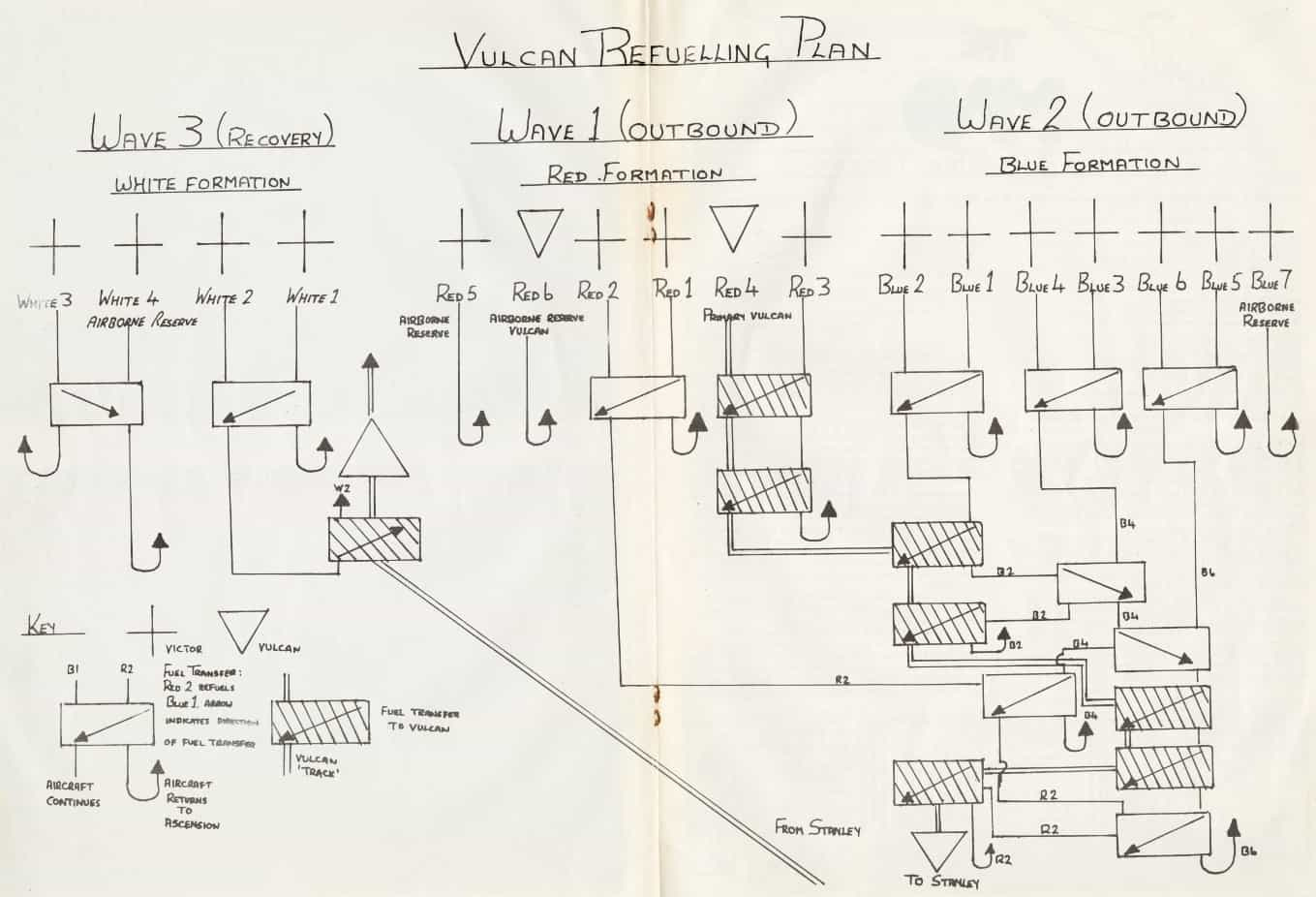
It is the wagon equation in tangible form. Planes refuelling other planes to refuel planes. The long-term solution to this would be establishing bases at islands along the way, sending fuel to these islands, and then sending planes that “island hop” until they reach their destination. The US pursued this strategy during WW2 to fight the war in the Pacific.
We had to fly those planes from the bases in Kansas to India. Then we had to fly fuel over the hump into China. [...] We were supposed to take these B-29s—there were no tanker aircraft there. We were to fill them with fuel, fly from India to Chengtu; offload the fuel; fly back to India; make enough missions to build up fuel in Chengtu; fly to Yawata, Japan; bomb the steel mills; and go back to India. We had so little training on this problem of maximizing [fuel] efficiency, we actually found to get some of the B-29s back instead of offloading fuel, they had to take it on. To make a long story short, it wasn’t worth a damn. And it was LeMay who really came to that conclusion, and led the Chiefs to move the whole thing to the Marianas, which devastated Japan.
— McNamara, Robert, “The Fog of War.” 2003.
The modern US Navy sidesteps this problem with a little help from a magical substance called Uranium. Modern US aircraft carriers operate for 25 years between refueling.6 As of writing, there are multiple aircraft carriers in operation somewhere in the world that were refueled before some of this blog’s readers were born. Uranium and Plutonium are magic under other names.
But what if you don’t have a stockpile of Highly-Enriched Uranium and a fleet of multi-billion dollar aircraft carriers? Then your only recourse is a Forward Arming and Refueling Point (FARP). Or some logistical combination of Forward Operating Bases, Forward Operating Sites, and Main Operating Bases.7 Each base acts as a resource buffer in your supply chain – allowing your troops to go from link-to-link-to-link while re-supplying at each point. It’s the same strategy the US Army Air Forces used for operations in WW2, what pony express used to send mail, Edward I used for his invasion conquest of Wales, and the strategy Edward I’s distant descendants used to manage the British navy’s ever increasing need for coal.8
Castles were the FARPs of the past, amongst other things,
The castle was also a storehouse for munitions, an advanced headquarters, an observation post in troubled areas, home of a lord, and a place where he could be secure from attacks by his enemies. Royal castles could in times of emergency act as havens for the king’s field army, or supply the men to raise a new army if the field army was defeated… [They were] not a place of refuge, but a centre of military power.
— Wise, Terence. “Medieval Warfare.” New York: Hastings House, 1976.
Castle garrisons would steal forage9 from the land around them and create stockpiles of resources so that armies could use them as Forward Operating Bases/Sites when necessary. Each castle would be spaced one day’s march apart from the others, allowing armies to hop across the countryside. This strategy was central to medieval warfare. It’s why wars were fought castle-to-castle, siege-to-siege — disrupting this network was crucial for the enemy to gain territory.
When William I, or William the Conqueror, invaded England in the 11th Century, he used castles to secure territory. Lots and lots of castles. When his troops would first arrive at a new site, the first thing they would do would be to find a spot for a motte-and-bailey. Once a spot was identified, they would descend and build the castle as quickly as possible.
Orderic Vitalis gave the lack of castles in England as one reason for its defeat: ‘the fortifications [munitiones] called castles [castella] by the Normans were scarcely known in the English provinces, and so the English — could put up only a weak resistance to their enemies’.
— Turner, Ralph V. “Castles, Conquest and Charters: Collected Papers.” (1992).
As castles became more expensive and elaborate, they would require more than just troops in the field. They required masons, engineers, and castle specialists — expensive specialists. Regents would build castles until bankruptcy, take on debt, and then continue building more anyway. And it was a completely rational course of action at the time — castles were simply that important.
But what if the cornerstone of power in your society becomes obsolete? What if the strategy that has held true for over 500+ years10 becomes irrelevant in an afternoon?
For nearly 500 years castles were a source of power for medieval societies, what happens then? Well… that’s for Part 2.
This series is the result of something I’ve been thinking about since the pandemic and is the synthesis of parts from several books + papers and discussions with friends. Sources include,
Bur, Michel. “The Motte and Bailey Castle: Instrument of Revolution.” Engineering and Science 45.3 (1982): 11-14. Accessible here.
Slavin, Philip. “Chicken husbandry in late-medieval eastern England: c. 1250–1400.” Anthropozoologica 44.2 (2009): 35-56. Accessible here.
Kelly, Jack. “Gunpowder: alchemy, bombards, and pyrotechnics: the history of the explosive that changed the world.” Basic Books (AZ). (2004).
Brauer, Jurgen, and Hubert van Tuyll. “Castles, Battles, & Bombs: How Economics Explains Military History.” (2008).
Granberry, G., et al. “The Age Of Gunpowder: An Era of Technological, Tactical, Strategic, and Leadership Innovations.” Emory Endeavors in History Series. (2014).
US Department of the Army. “The law of land warfare.” Field Manual 27-10 (1956).
LLMs lack a sense of taste so I don’t use them for writing. My writing style and approach is just too out there for most LLMs. I am (alas) an entirely carbon-based user of the em dash.
What I do use them for is augmenting my executive function and extracting data from digital copies of the books and papers I’ve read (doing it manually takes a lot of time).






![[Web dev for beginners] CSS: Learn the essentials quickly](/image/r?src=templates/thedailycurrents.com/v8/images/categories/14.jpg&w=825&h=520&zc=1)